Lineworker
Craft Career
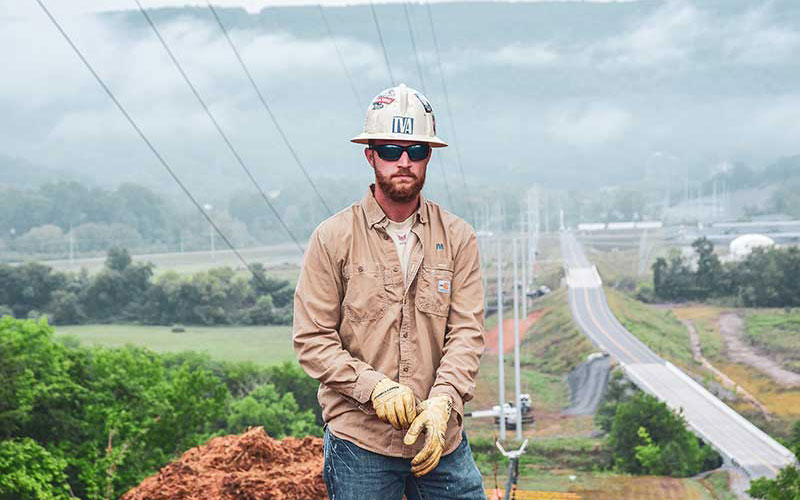
Addison Beene helps keep electricity flowing in small towns across the Valley region.
He’s a lineworker foreman for the Tennessee Valley Authority.
His family has a long history with TVA. His great-grandfather, James Beene Sr., joined TVA in 1952, and his grandfather and uncle also worked there.
“I’ve known this is always what I wanted to do. I grew up learning to tie knots for rigging,” Beene said. “I started before my grandpa retired, continuing the over 60-year tradition at TVA and 76-year history with the International Brotherhood of Electrical Workers. Linework is always something that has inspired me.”
A Day in the Life
A lineworker’s life is far from ordinary.
They often work high in the air, sometimes 500 feet up on towers.
They may spend hours in a bucket truck.
They often work more than 40 hours in a week, especially during storms or emergencies.
The work demands skill, strength and nerves of steel.
Safety First
Safety is a priority for TVA and its teams.
Power lines carry a lot of electricity – some up to 500,000 volts, which can be deadly.
Electricity can jump through the air, so workers must be very careful.
Crews use safety gear and usually turn off the power when working.
“It doesn’t matter how many times you do it. You have to stay on your toes to make sure everyone goes home at the end of the day,” Beene said.
Becoming a Lineworker
TVA offers a lineworker apprentice program that teaches people the skills to be a lineworker. Candidates for an apprenticeship need:
- High School Diploma or equivalent
- Valid Driver’s License
- Pass an aptitude test
- Training includes:
- A four-day bootcamp
- A 10-week climbing school
- A four-year apprenticeship.
Apprentices work alongside experienced lineworkers. They are paid while they train for the job. Apprentice pay starts at $62,895 and increases to $93,795 by the end of the four-year program. After that, they can become journeymen lineworkers, making over $110,345 a year.
There’s a growing need for lineworkers across the country. Many jobs will open as people retire or leave the field. And new workers are needed to help keep the electric grid reliable.