'%3E%3Cmask id='b' fill='%23fff'%3E%3Cuse xlink:href='%23a'/%3E%3C/mask%3E%3Cuse fill='%23414141' xlink:href='%23a'/%3E%3Cg mask='url(%23b)' fill='%23414141'%3E%3Cpath d='M-160-170h300v300h-300z'/%3E%3C/g%3E%3C/g%3E%3C/g%3E%3C/svg%3E)
Operation Osprey
Teamwork saves injured bird atop South Holston Hydro plant
High above the power-producing dam at Tennessee Valley Authority’s South Holston Hydro plant, an emergency rescue mission recently unfolded.
Back in June, crews spotted an active osprey nest perched high on the plant’s crane and sluice tower.
Lori Whitehorse, TVA environmental program manager, contacted TVA terrestrial zoologist Sara McLaughlin-Johnson, who began regular monitoring with binoculars to make sure the birds – and the facility – stayed safe and compliant.
TVA balances energy production with environmental stewardship. It’s been part of TVA’s mission as a federal agency since its founding.
And it’s also the law.
Birds are protected under the Migratory Bird Treaty Act, which prohibits moving or disturbing birds, their nests, eggs and chicks without appropriate permits.
“We usually limit activities within 660 feet of active nests,” said McLaughlin-Johnson.
When chicks eventually fledge – fly away – TVA resumes normal activities in the area.
“We usually see the chicks fledge by late July or early August,” said McLaughlin-Johnson.
But that time came and went. Something about this chick was different.
On a hot Monday in mid-August, the reason for the delay became clear.
Whitehorse contacted McLaughlin-Johnson with alarming news.
Ron Weaver, a wildlife photographer using a telephoto 800 mm lens, had spotted monofilament fishing line wrapped tight around the osprey chick’s leg.
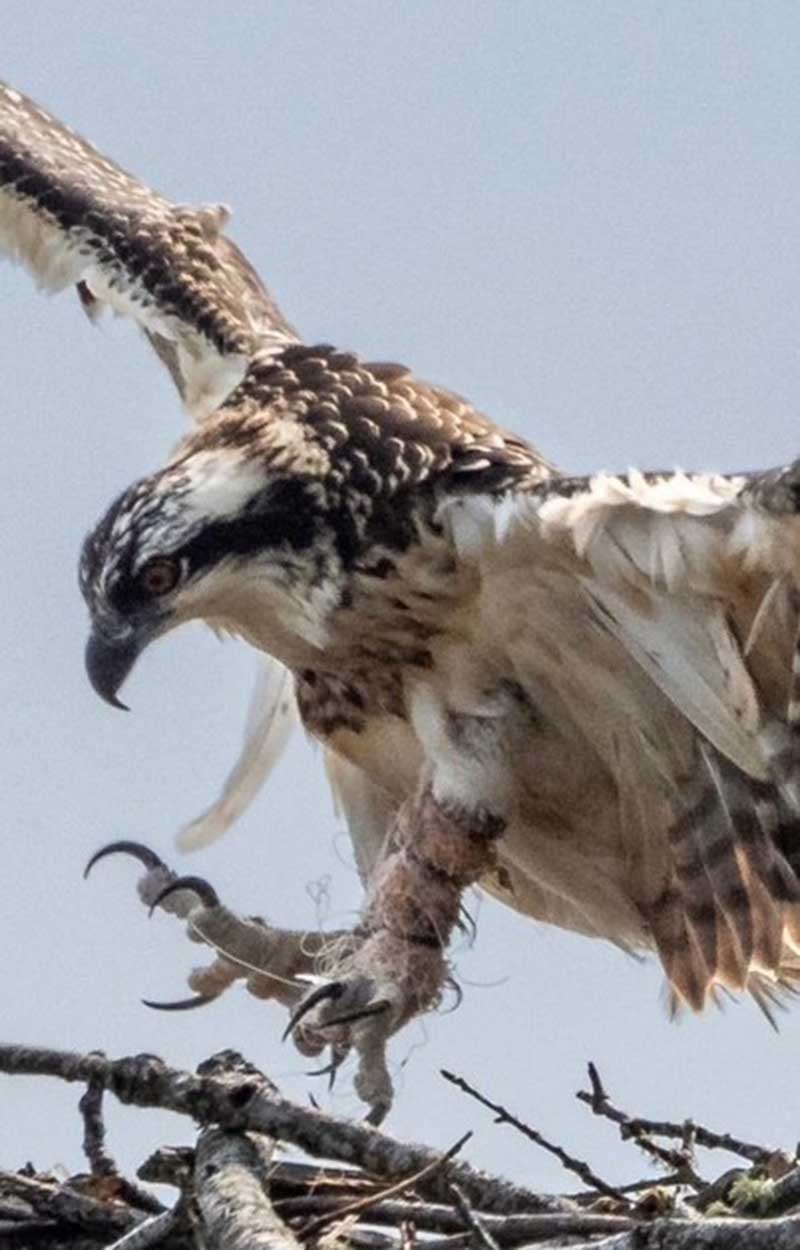
Photos courtesy Ron Weaver
He had called Lisa Thomison of Owl Ridge Raptor Center, who called several people at TVA before eventually reaching Whitehorse, who routed the message back to McLaughlin-Johnson.
That started the rescue mission.
Although McLaughlin-Johnson had been using binoculars and a camera, her 300 mm zoom couldn’t see the almost invisible line wrapped around and cutting ever deeper into the tiny leg.
“I was honestly shocked,” McLaughlin-Johnson said. “I reached out to TVA’s Jake Shockey, who put me in touch with South Holston Hydro staff Chad Newton and Matt Lemon.”
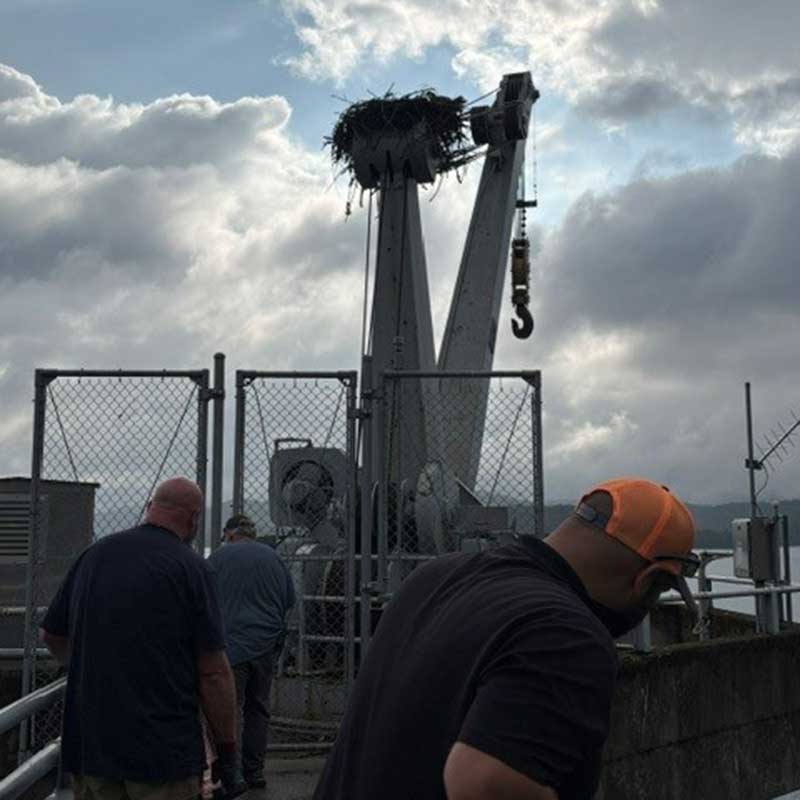
The next morning, armed with 20-foot extension ladders, TVA’s Newton, Lemon and McLaughlin-Johnson met Weaver, the photographer, and Wes Rines, a falconer from Owl Ridge Raptor Center.
They contemplated how to safely scale the sluice tower.
Capturing an osprey is no easy task: the parents have piercing talons and their beaks are crafted to grasp and tear fish flesh.
And ospreys are very protective parents.
Rines stepped onto the ladder.
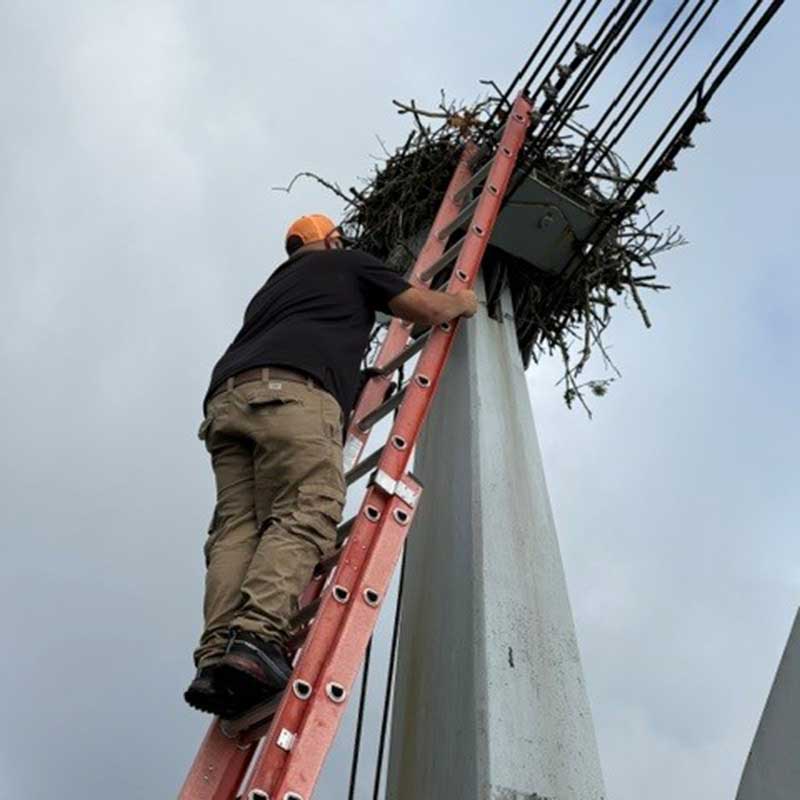
“We believed the osprey chick could not fledge . . . because the monofilament was tethering it to the nest,” McLaughlin Johnson said. “However, when Wes (Rines) climbed the ladder, the chick unexpectedly flew off.”
The bird, new to flight and tangled in the line, lost altitude over the reservoir and tumbled into the deep water.
“Our hearts sank – we were afraid the chick would drown,” McLaughlin-Johnson said.
The South Holston crew acted fast.
“The chick was floating closer to the dam and was actually able to grab onto a fallen tree,” McLaughlin-Johnson said. “He was soaking wet and exhausted, but alive.”
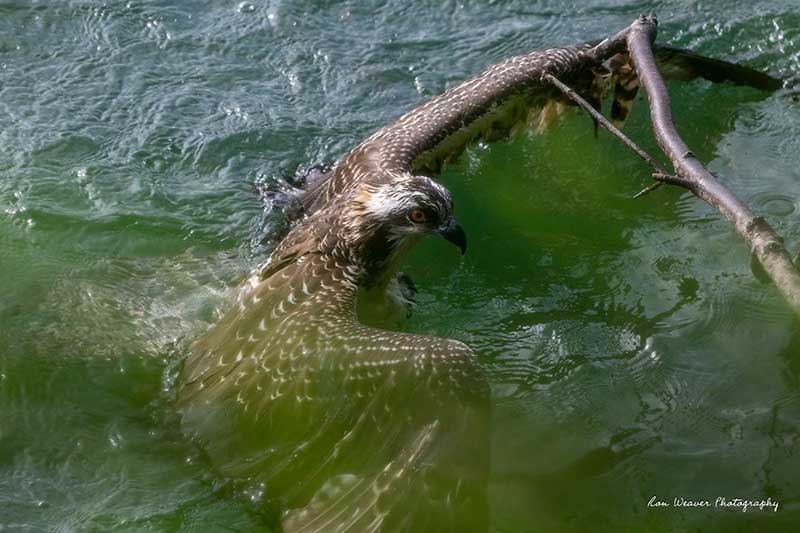
From the dam, a cliff plummeted straight down to the water.
A TVA kayak was the only way to access the water, but the boat proved way too small for Rines.
“That’s all you, Sara,” Rines said to McLaughlin-Johnson.
She nervously accepted.
“I’ve handled small owls, helped capture an injured red-tailed hawk, and put jesses on a great horned owl once before, but have little raptor handling experience otherwise,” McLaughlin-Johnson said.
But Rines gave her step-by-step instructions, and off she paddled with leather gloves, a falconer’s cap to slip over the osprey’s eyes and a large towel.
She paddled within reach of the bird, who eyed her every move.
“Then I said a little prayer and quickly grabbed him by the base of his tail, so I could control his lower body and avoid his sharp talons,” McLaughlin-Johnson said.
She slipped the cap over his head, hoisted him onto the kayak and tossed the towel over his body, tucking it snug against his wings to secure his talons and head.
She gripped the wrapped bundle as she paddled the kayak back to shore.
There, she handed him off to the falconer who painstakingly unwound the deeply embedded fishing line from the osprey’s foot, badly injured left leg, body and wing while McLaughlin-Johnson held the bird steady.
“After about 30 minutes, we had removed all the fishing line and cleaned and disinfected the wounds,” McLaughlin-Johnson said.
They carefully loaded the bird into a pet crate for the long drive to the raptor center.
Only then did they take a deep breath and relax.
“Everyone high fived, sort of in disbelief that we had pulled off this crazy rescue,” she said.
Rines rushed the osprey – whom they named Weaver, in honor of the photographer who doggedly tracked down help for the bird – to Owl Ridge Raptor Center.
“Later in the day, I received updates on Weaver,” McLaughlin-Johnson said. “He’s on antibiotics and pain medication. One of his toes is disfigured because of the fishing line, and he will be doing physical therapy with Wes (Rines) while in rehabilitation to help regain use of his left foot.”
Despite his injuries, rehabilitators expected Weaver the osprey to make a full recovery and be released by February or March, 2027.
Yet he had another surprise up his wing.
“He did so well in rehab that he was able to be released on September 16, with enough time to migrate,” said McLaughlin-Johnson.
And he wasn’t alone. Weaver ended up being released with a bird buddy he made in rehab.
Share this story: ' fill='%23414141'%3E%3Cpath d='M0 0h314v314H0z'/%3E%3C/g%3E%3Cg transform='translate(6 4)'%3E%3Cmask id='d' fill='%23fff'%3E%3Cuse xlink:href='%23c'/%3E%3C/mask%3E%3Cuse fill='%23FFF' xlink:href='%23c'/%3E%3Cg mask='url(%23d)' fill='%23FFF'%3E%3Cpath d='M-149-165h300v318h-300z'/%3E%3C/g%3E%3C/g%3E%3C/g%3E%3C/svg%3E%0A)
' fill='%23414141'%3E%3Cpath d='M0 0h314v314H0z'/%3E%3C/g%3E%3Cg transform='translate(4 5)'%3E%3Cmask id='d' fill='%23fff'%3E%3Cuse xlink:href='%23c'/%3E%3C/mask%3E%3Cuse fill='%23FFF' xlink:href='%23c'/%3E%3Cg mask='url(%23d)' fill='%23FFF'%3E%3Cpath d='M-167-171h323v327h-323z'/%3E%3C/g%3E%3C/g%3E%3C/g%3E%3C/svg%3E%0A)
' fill='%23414141'%3E%3Cpath d='M0 0h314v314H0z'/%3E%3C/g%3E%3Cg transform='translate(4.26 4)'%3E%3Cmask id='d' fill='%23fff'%3E%3Cuse xlink:href='%23c'/%3E%3C/mask%3E%3Cuse fill='%23FFF' xlink:href='%23c'/%3E%3Cg mask='url(%23d)' fill='%23FFF'%3E%3Cpath d='M-150-157h300v300h-300z'/%3E%3C/g%3E%3C/g%3E%3C/g%3E%3C/svg%3E)
Want more stories from The Powerhouse? Sign up to receive a monthly digest in your email.