'%3E%3Cmask id='b' fill='%23fff'%3E%3Cuse xlink:href='%23a'/%3E%3C/mask%3E%3Cuse fill='%23414141' xlink:href='%23a'/%3E%3Cg mask='url(%23b)' fill='%23414141'%3E%3Cpath d='M-160-170h300v300h-300z'/%3E%3C/g%3E%3C/g%3E%3C/g%3E%3C/svg%3E)

The Great Electric Tent Show Revival and Jubilee
TVA Shares How Electricity Would Change Lives
When we wax nostalgic for the early days of television, we tend to forget that the late ’40s and early ’50s weren’t the beginning of the TV age for all Americans. Where thousands across the TVA region were concerned, it wasn’t even the electric age yet.
Many American cities, including those in the Tennessee Valley region, were wired for electricity as far back as the 1880s. By 1900, electric lights, streetcars and appliances were commonplace in Memphis, Knoxville, Huntsville, Chattanooga. But out in the country, it was still dark. Private industry hadn’t found it profitable to electrify sparsely populated areas.
The New Deal’s Rural Electrification Act of 1935 got the ball rolling, but, said TVA retiree Bob Rice, progress was slow.
It wasn’t until after World War II that most farmers across the region had access to electric power. “And when they did get electricity, they didn’t know what to do with it,” Rice said.
It was his job to show them.
Electricity on Parade
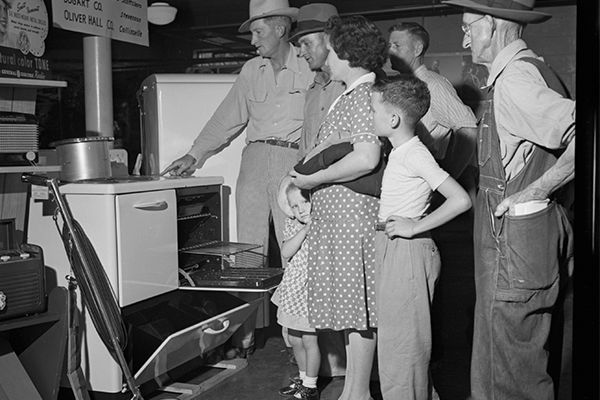
Farm families must have looked on in wonder when the five open-bed International Harvester trucks rumbled in a convoy over dirt roads and pulled off into empty fields across the region in the 1950s. Once they found a good flat place, Rice and about seven hired hands — mostly students from Mississippi State, North Carolina State or the University of Tennessee — would unload their trucks.
A couple of trucks were stacked with huge pieces of canvas. Another was full of long poles. Another carried a wooden stage. Rice and his crew would stretch out the canvas and put up an oblong tent, 160 feet long by 60 feet wide.
“We called it the appliance tent,” Rice recalled.
Then they’d erect another tent, this one about the same size but closer to square, 120 feet by 80 feet.
“We called that the auditorium tent,” said Rice.
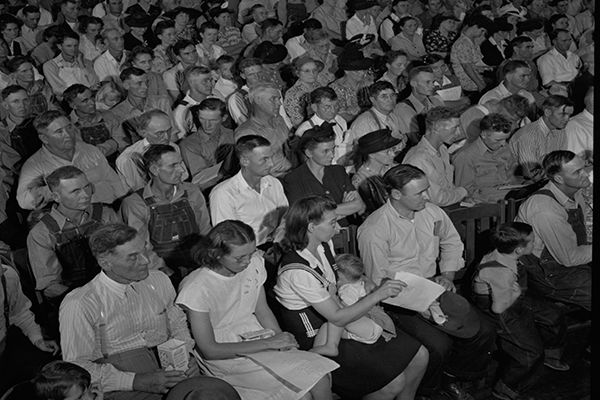
With room for 1,200 chairs, it was big enough for a circus. But the main purpose wasn’t entertainment. This was an electric show, a cooperative effort by the Tennessee Valley Public Power Association and TVA to bring power to the people and show them how to use it.
Rice’s team would set up a public-address system to attract attention and spread the word. Sometimes, country musicians played free shows in the tents. Among them was the young Buck Owens, a Californian trying to catch on with audiences in the Tennessee Valley region. Other times, popular politicians like Tennessee Sen. Albert Gore Sr. would come and warm up the crowd as only a Southern politician can.
Then Rice and his helpers would roll out the main attraction: a demonstration of the wonders of electricity.
They showed the audiences how to put together electric light fixtures with pull-chains or wall switches. They showed how electric washers and dryers and stoves worked. They showed how refrigerators and freezers could keep food fresh. They showed what could be done with automatic water pumps, which made indoor plumbing possible. The shows amazed the farmers, educated them and ultimately changed their lives.
Rice and his convoy moved from place to place like evangelists on the camp-meeting circuit.
“We went everywhere,” Rice said, from the hills of northeastern Tennessee to the flat, steamy Mississippi delta. They usually did just one daylong show per week: a day or two for driving, a day for setting up, a day for showing, a day for breaking it down and packing it all up again.
Almost always, things went smoothly, and the men became more and more efficient as time went on.
“Usually all I worried about was whether the sound system would go out in the middle of Senator Gore’s speech,” said Rice.
A Scary Storm
But there was one day when he had more serious concerns. It’s a day he remembered better than any other.
“We’d just set up at Mississippi State in Starkville. Of course, I realized these tents had a lot of wind resistance, but they were strongly reinforced with good rope.” The side poles were anchored by big heavy rods driven into the ground. Rice remembers being told that they were Model A axles.
He and his crew had just finished setting up the auditorium tent and several hundred of the chairs when an afternoon thunderstorm blew in. “We all huddled under that thing,” Rice recalled.
He had several reasons to worry. First, an ever-widening pool of water was collecting in the folds of the tent overhead. “I didn’t know how much water it would hold,” he said. The strong wind was also a concern; he knew they were in a land that often breeds tornadoes.
“The wind was blowing like the mischief,” Rice said. The storms of Mississippi have little regard for human strivings, and this was one of Faulknerian proportions. As they huddled beneath the tent, it gave way, blown apart by the wind. Even the heavy Model A axles flew up into the air.
“The tent and these big heavy stakes went flying right over our heads,” said Rice. The mishap could have killed them all, but no one was badly hurt.
“It was dramatic,” Rice summed up, a Mississippi understatement.
Most people might have canceled or postponed the Starkville show, but as soon as the storm subsided, Rice and his comrades went back to work. They recovered the tents, both of which were badly torn.
“We had some sailmaking needles, and one of the men had done this in the Navy. So, we started patching those things.” The tents were ready just in time.
Rice never forgot the Starkville episode. “Every time after that, when we had people in the tent and a storm came up, I was on pins and needles.”
He stayed with the project until it was disbanded in 1955.
“It was great fun, a great experience,” Rice said. “We found quite a camaraderie.”
Today, few people in even the remotest communities would be impressed with an electric tent show. Electricity and its many uses are something every farmer knows about. Many farms today are equipped with satellite dishes and computers.
Rice was always regretful about how well he and his helpers did their job. “You couldn’t do that now,” he lamented. “Everyone’s too sophisticated.”
He had only himself to blame.
Share this story: ' fill='%23414141'%3E%3Cpath d='M0 0h314v314H0z'/%3E%3C/g%3E%3Cg transform='translate(6 4)'%3E%3Cmask id='d' fill='%23fff'%3E%3Cuse xlink:href='%23c'/%3E%3C/mask%3E%3Cuse fill='%23FFF' xlink:href='%23c'/%3E%3Cg mask='url(%23d)' fill='%23FFF'%3E%3Cpath d='M-149-165h300v318h-300z'/%3E%3C/g%3E%3C/g%3E%3C/g%3E%3C/svg%3E%0A)
' fill='%23414141'%3E%3Cpath d='M0 0h314v314H0z'/%3E%3C/g%3E%3Cg transform='translate(4 5)'%3E%3Cmask id='d' fill='%23fff'%3E%3Cuse xlink:href='%23c'/%3E%3C/mask%3E%3Cuse fill='%23FFF' xlink:href='%23c'/%3E%3Cg mask='url(%23d)' fill='%23FFF'%3E%3Cpath d='M-167-171h323v327h-323z'/%3E%3C/g%3E%3C/g%3E%3C/g%3E%3C/svg%3E%0A)
' fill='%23414141'%3E%3Cpath d='M0 0h314v314H0z'/%3E%3C/g%3E%3Cg transform='translate(4.26 4)'%3E%3Cmask id='d' fill='%23fff'%3E%3Cuse xlink:href='%23c'/%3E%3C/mask%3E%3Cuse fill='%23FFF' xlink:href='%23c'/%3E%3Cg mask='url(%23d)' fill='%23FFF'%3E%3Cpath d='M-150-157h300v300h-300z'/%3E%3C/g%3E%3C/g%3E%3C/g%3E%3C/svg%3E)
Want more stories from The Powerhouse? Sign up to receive a monthly digest in your email.